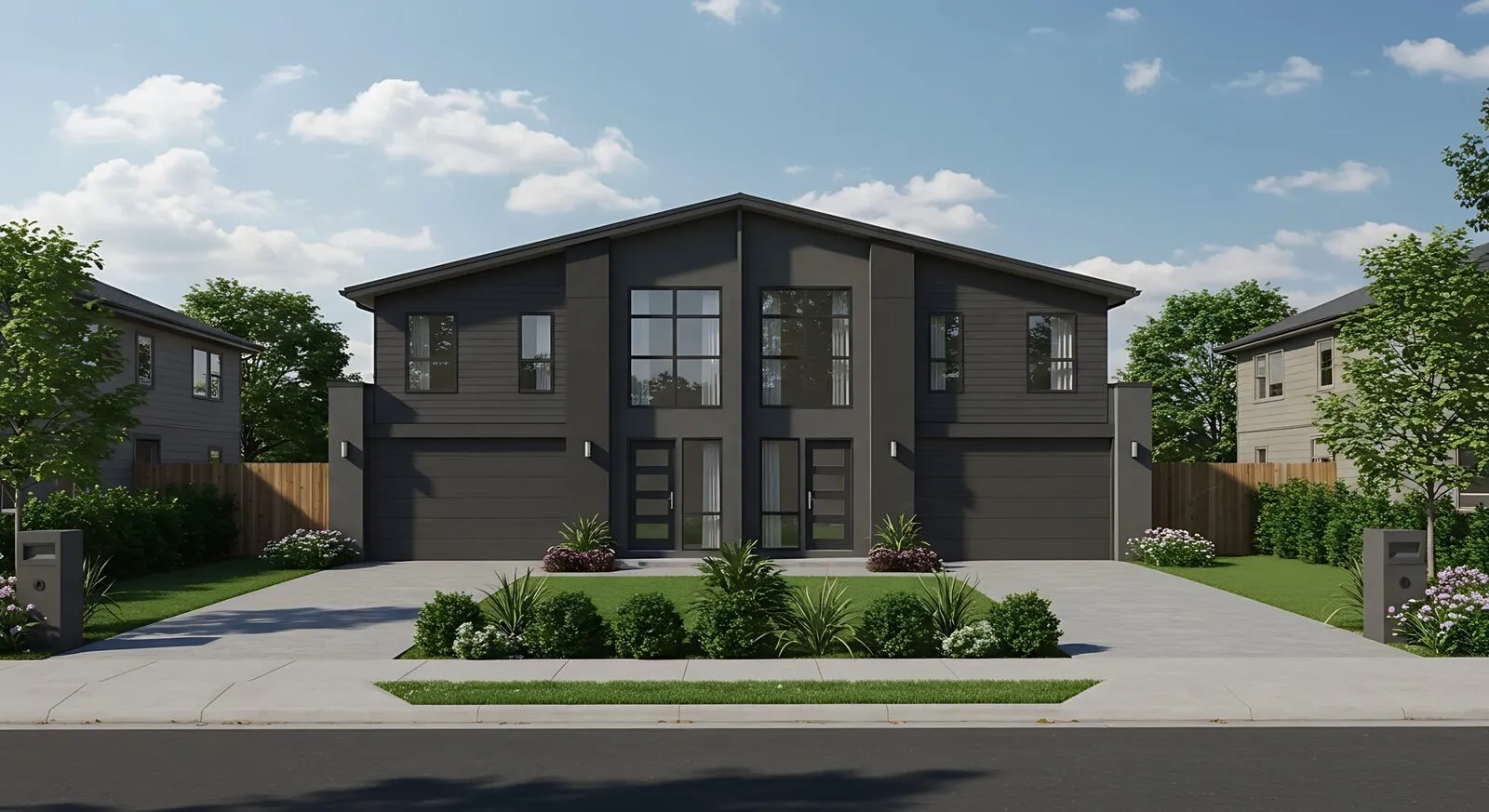
Splitting a Duplex: Subdivision or Community Title?
The two ways to separately title a Queensland dual occupancy, how each affects the design and services, and why the decision has to be made before you build.
Decide before you design
If you intend to sell the halves of a duplex separately, the title path has to be decided before the design is drawn. It affects where the boundary sits, how the services are laid out, and sometimes the structure of the building itself.
Retrofitting a title split onto a building designed as a single-title dual occupancy ranges from expensive to impossible.
This is the most common expensive mistake in small-scale development, and it is entirely avoidable by answering one question early: what do you intend to do with this when it is finished?
Standard format: dividing the land
A standard format subdivision divides the land itself, creating two separate lots each with its own title, defined by boundaries on the ground.
Each dwelling sits wholly within its own lot, each has its own services connected independently, and each owner owns their land outright with no shared property and no body corporate.
This is generally the cleanest outcome and the one buyers prefer, because it produces two ordinary houses on two ordinary lots. Valuers and lenders treat them straightforwardly.
The catch is that it requires the site to support two compliant lots — each meeting minimum lot size, frontage and dimension requirements, each with its own legal access and its own services. Plenty of duplex sites cannot achieve this.
Building format: dividing the building
A building format plan defines lots by reference to the structure — floors, walls and ceilings — rather than by boundaries on the ground. This is how apartments and most townhouse developments are titled.
It creates a community titles scheme with a body corporate, common property, shared insurance and ongoing administration.
The advantage is that it works on sites where a standard format subdivision cannot, because the lots do not need to independently satisfy minimum land requirements in the same way.
The disadvantages are the ongoing body corporate obligations, the shared insurance and maintenance arrangements, and the fact that some buyers and some lenders view a two-lot scheme less favourably than two freestanding titles.
What it changes in the build
Services are the biggest practical difference. Separate titles generally want fully independent connections — separate water meters, separate electrical supply, separate sewer connections — and running those independently has to be designed from the start.
The common wall and its fire and acoustic separation requirements are affected by whether the dwellings are separately titled, and the requirements for a fire-separating wall between separately titled dwellings are specific.
Access, driveways and where the boundary sits relative to eaves, gutters and footings all need to be resolved on the plan rather than discovered by the surveyor afterwards. An eave overhanging a boundary is a problem; a footing crossing one is a bigger problem.
The process
Both paths involve a surveyor preparing a plan, council approval of the reconfiguration or the scheme, and lodgement with the titles office. Both take time, and both should run in parallel with construction rather than starting at completion.
Get a surveyor involved at design stage. They will tell you quickly whether a standard format subdivision is achievable on your site, which is the question that determines everything else.
Speak to a lender early too if finance is involved, because how the project will be titled affects how it is valued and funded.
We plan the title path into the design from the first meeting. Our dual occupancy feasibility checklist covers the other checks worth doing before you buy the block.